Princess Embroidery on Silk

Princess Embroidery on Silk

First off, thanks so much for the embroidery tips!  I started with simply adding letters on sueded silk, just trying to get a grip on rotating the word and changing the overall size.  I am happy to announce, embroidering letters is much easier than I thought.

angelawolf400124

I choose a font from the Brother Dreamweaver XE and all you have to do is push the letters on the touch screen.  Changing from upper case to lower case is a breeze.  Then another push of the button and the entire word rotated directions.  (I know I said no monogram towels for Christmas gifts, but I think I changed my mind – this is way too much fun!  Now I just need the machine to offer spell check :))

angelawolf400114angelawolf400116

So here is where I screwed up … I was in a hurry and  grabbed a bobbin that was 1/3 full.  Instead of taking all that thread off the bobbin and starting fresh, I added more thread to that bobbin.  Not a big deal, unless you run out of bobbin thread!   This sewing machine has an automatic sensor that tells you when you are going to run out of thread.  Very cool feature, unless the machine doesn’t know you are going to run out of thread, which is exactly what happened here.  I was lucky the thread ran out at the end of my first “S”, but I still had to line up another “S” or change my idea to Princes (on pink fabric).  I played around with the laser light and found that I could tell the machine where to start the last letter.  Not too shabby!

angelawolf400121

angelawolf400123

I have big design ideas for my newly found passion for embroidery, but for the first few tests I am going to work on small pieces of fabric and share with those of you that are as much a novice as I am on this.

A few emails rolled in about how exactly to embroidery the jeans and I thought this photo might help.  Remember there were 3 hoopings on each leg.  The front pockets were already attached and the back was finished, except for the back pocket.  I waited to add the back pocket because I was worried the fabric would be too thick under the embroidery hoop.  You can see how the design started large near the hip, then smaller, and then even smaller at the ankle.

IMG_9818

I am off to buy more embroidery thread and needles.  Thanks to many of you for your advice, I think this is going to be fun.  In the next post I will show you what the Princess is for and add more texture to the fabric.  Have a great week!  Cheers 🙂  Angela

DIY Project: How to Sew Fleece Texting Gloves

DIY Project: How to Sew Fleece Texting Gloves

texting gloves angela wolfThis is a fun and easy sewing project; sewing fleece texting gloves.  You know I can’t resist coming up with a few fun gifts items to sew. How about a pair of texting gloves! I don’t know about you, but I really get annoyed when I have to take off my gloves in order to answer my phone, text, or check an email. Instead of buying gloves and cutting off the fingertips, I decided to whip up a pair of custom gloves. These are easy and fast to sew, not to mention you can customize how tight and tall you want them and not worry about your rings getting in the way.  Did I mention they are GREAT for fishing!

The video below walks you through the entire process, including another glimpse at the V-Sonic Pen Pal feature on the Brother Dreamweaver XE.  In short, here are the steps:

1.  Measure around your knuckles, this will be the width of your gloves.

2.  Measure from your knuckles up your wrist and come up with a length measurement.

3.  Chalk mark your stitch lines, making sure to block out the area for your thumb.

4.  Stitch and press your seam allowance open.

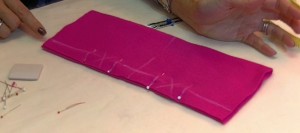
5.  Fold the glove in half so the folded edge is at your knuckles.text gloves Angela Wolf

6.  Hand stitch the thumb hole closed.

7.   Serge the raw edge.

That’s it!  You can add beading, decorative stitching, embroidery … by the way, if you add embroidery, do so before you sew the gloves together.  This is such an easy project.  Show everyone how creative you are and post photo’s on my facebook, Instagram, and pinterest of your new gloves.  Let me know if you have any questions.

Cheers and stay warm!


Brother™ has provided me with the DreamWeaver XE, but all opinions expressed are entirely my own.

www.AngelaWolfPatterns.com

How to sew topstitching that looks professional on jeans and jackets …

How to sew topstitching that looks professional on jeans and jackets …

I hope you are all safe from hurricane Sandy and my heart goes out to all those affected.  We even experienced severe weather here in Michigan!   I made it to the beach yesterday and after getting stuck in the sand with our SUV, I was able to snap a few shots.  Unbelievable waves on Lake Michigan, over 20 footers.  I think I’ll pass on fishing for a few days 🙂

Lake Michigan during hurricane Sandy …over 20 foot seas!

Now onto sewing …. more specifically topstitching.  Topstitching jackets and jeans are not only a designer touch; this has become a main focus in today’s fashion.  The more creative the topstitching the more expensive your garment looks.  On that note, have you ever finished a great looking jacket only  to discover  you can’t find a matching color in the thick topstitching thread?  Would you like to hem your favorite jeans – again not being able to match the original jean thread color.  This video shows you an easy way to solve that problem, using two spools of Coats & Clark polyester thread and a #14 denim jean needle.  You will even get a peek at the automatic needle threader on the Brother Dreamweaver XE, yes it even works with 2 threads!  Enjoy 🙂

[youtube=http://www.youtube.com/watch?v=HtKotSXYreI&feature=plcp]

Brother™ has provided me with the DreamWeaver XE, but all opinions expressed are entirely my own.

How to Make Bias Tape the Easy Way with Simplicity

How to Make Bias Tape the Easy Way with Simplicity

[youtube=http://www.youtube.com/watch?v=FofSArIc7RM&context=C4c6673eADvjVQa1PpcFODx7nLiq6DH_2CPj4HCzz1QByuUKW2TV8=]

Making bias tape has never been easier!  It is really important to make sure your bias strip are really cut on the true bias.  Here are a few tips to make sure you have success:

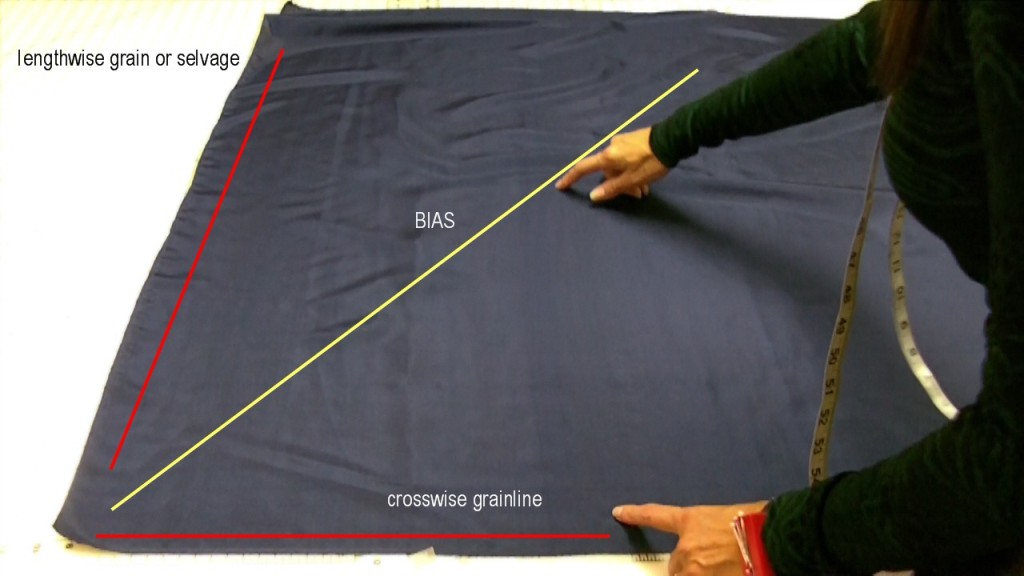
 To find the true bias:  lay your fabric on a flat surface.  It is easier if there is a grid to follow in order to line up your grainlines.  Here I line up the crosswise grainline and the fabric salvage.

Take one corner and pull the fabric to match the selvage with the crosswise grain.  This will create a triangle.

When working with slippery fabric, use a weight at one end so you can maneuver the fabric around.  The bias is along the folded edge.

Align a see through ruler along the bias edge.  I want 2″ bias strips so the first cut will be at the 1 inch mark because I am on the fold.

Now you will see you have a nice cut line on the bias.  I then take the bias line and fold the fabric in half, so I don’t have to cut so far.  I also move the fabric so I can line up the edge of the fabric along my grid underneath.

Again, using the see through ruler, cut every 2 inches.

Keep cutting strips until you run out of fabric.  I always cut more than I need, you never know when you might need a strip of bias!

Does anyone have any other tips for cutting bias strips …  especially when cutting slinky, slippery fabric?  I would love to hear your ideas.

Pin It on Pinterest